
BIO‑MICRO is organised into ten interconnected Work Packages (WPs): six focus on the scientific content of the research program (WP1–WP6), and four provide the enabling framework in terms of training, management, impact and ethics (WP7–WP10). Together, they cover the pathway from analytical assay development and mechanistic work, through clinical studies and long‑term follow‑up, to high‑quality doctoral training, robust project governance, effective dissemination and strict ethical compliance.
SCIENTIFIC CONTENT
WP1 – Micronutrient measurements in erythrocytes and leukocytes
Lead: Reinier Haga Medisch Diagnostisch Centrum (NL)
The main aim of WP1 is to develop and validate highly sensitive assays to measure key vitamins (B1, B6, B9, C, D, E) and trace elements (zinc, copper, selenium) in very small volumes of erythrocytes and leukocytes. This should provide reliable intracellular micronutrient measurements that can be applied to clinical samples from critically ill patients.
WP2 – Functional markers of micronutrient status
Lead: Reinier Haga Medisch Diagnostisch Centrum (NL)
WP2 aims to identify and validate functional metabolic markers that reflect downstream enzymatic activity of the micronutrients of interest. Using high‑resolution LC‑MS and redox assays, the WP seeks to establish a panel of metabolites and redox pairs that together offer a more dynamic picture of micronutrient‑dependent pathways.
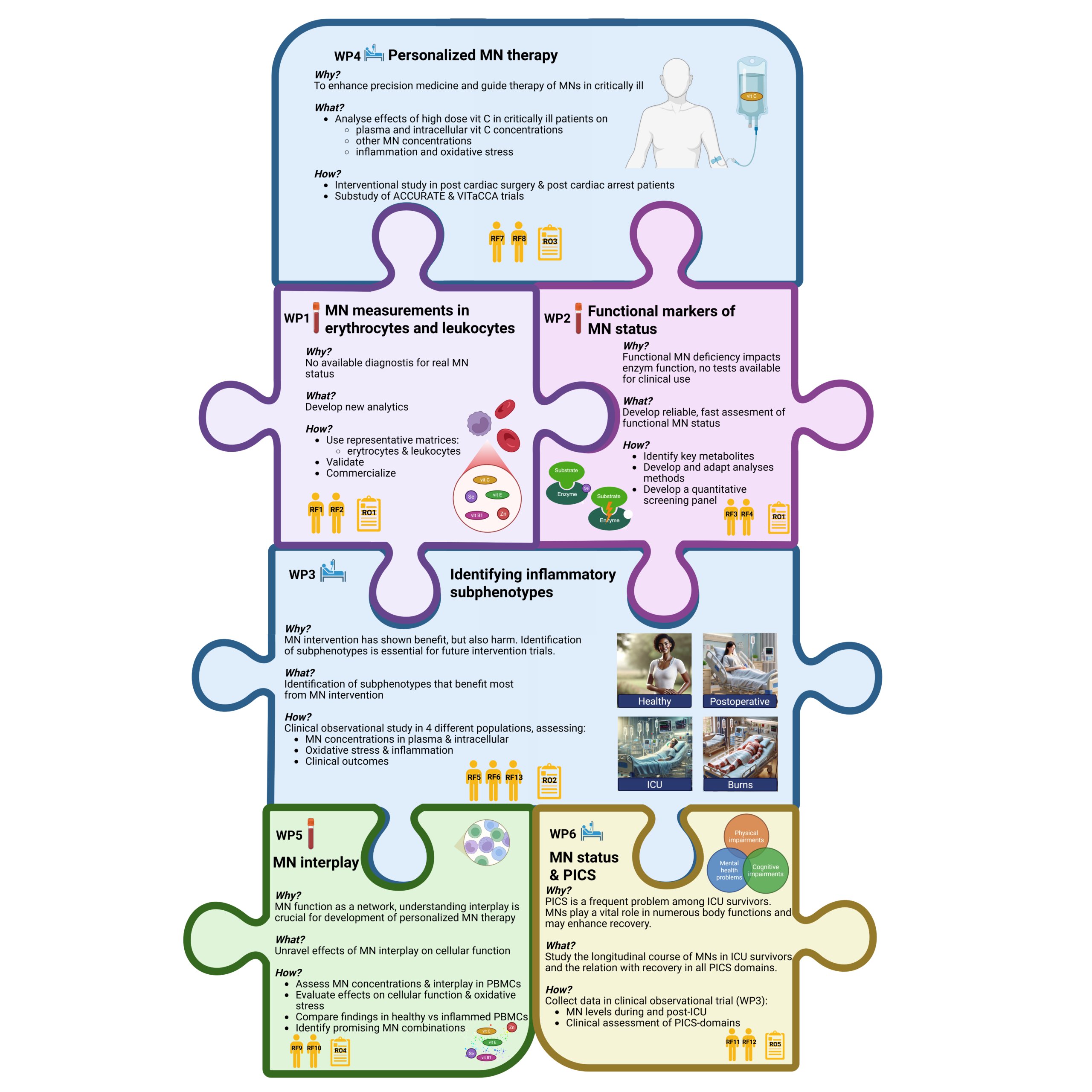
WP3 – Identifying inflammatory subphenotypes
Lead: Amsterdam University Medical Center (NL)
The objective of WP3 is to conduct a multicentre clinical observational study in healthy volunteers, cardiac surgery patients, critically ill patients and burn patients. It aims to combine longitudinal measurements of (functional) micronutrient status and point‑of‑care inflammation/oxidative stress markers with clinical outcome data to define patient sub‑phenotypes most likely to benefit from micronutrient interventions.
WP4 – Personalised micronutrient therapy
Lead: University Hospital of Würzburg (DE)
WP4 aims to evaluate the feasibility and clinical utility of point‑of‑care inflammatory measurements in ongoing intervention trials in cardiac arrest and cardiac surgery patients. A further aim is to assess whether biological phenotypes, derived from biomarker patterns, can be used to identify treatment responders and move towards personalised micronutrient therapy in critical care.
WP5 – Micronutrient interplay
Lead: University of Foggia (IT)
The purpose of WP5 is to combine a systematic review with in‑depth experimental studies in peripheral blood mononuclear cells (PBMCs) from healthy adults and critically ill patients. It aims to investigate how different micronutrients interact, how they affect cellular metabolism and mitochondrial function, and how these relationships change under inflammatory conditions.
WP6 – Micronutrient status and Post‑Intensive Care Syndrome
Lead: Gelderse Vallei Hospital (NL)
WP6 aims to characterise micronutrient and electrolyte status during the recovery phase after critical illness. It seeks to analyse trajectories of micronutrients and electrolytes in relation to physical, cognitive and psychological outcomes across PICS domains and long‑term clinical endpoints.
FRAMEWORK
WP7 – Project management
The goal of WP7 is to ensure effective governance, administration and data management across the consortium. It aims to coordinate the Supervisory Board, progress monitoring and reporting to the European Research Executive Agency, and to develop and maintain the Data Management Plan and secure data‑sharing infrastructure.
WP8 – Training
WP8 aims to design and deliver the BIO‑MICRO training programme for the 13 research fellows. It integrates local doctoral training, network‑wide workshops, secondments and individual Personal Career Development Plans to build T‑shaped skills that combine deep scientific expertise with broad transferable competencies.
WP9 – Dissemination, Exploitation and Communication
The aim of WP9 is to develop and implement the Communication, Dissemination and Exploitation Plan, including strategies for scientific publications, conference presentations, stakeholder engagement and public outreach. It also seeks to support innovation management, IPR handling and preparation for commercialisation of assays and point‑of‑care tools.
WP10 – Ethics requirements
WP10 aims to ensure that all project activities comply with EU and national ethical standards. It oversees the appointment and reporting of an independent ethics advisor/board and addresses issues such as vulnerable participants, informed consent, data protection, use of human samples and responsible use of AI, where applicable.